




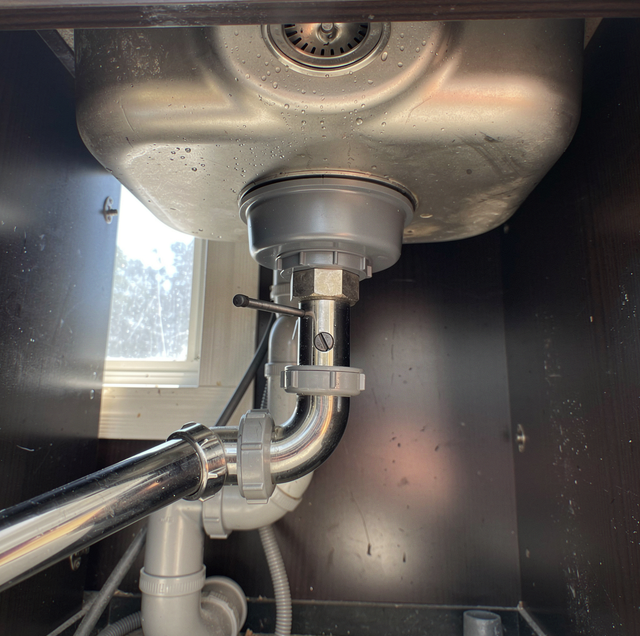
A garbage disposal that hums instead of grinding is receiving power, but something is stopping the impeller from turning. Whether that something clears with one check or means the motor itself is done comes down to a few minutes of work before anyone needs to call about a replacement. The hum alone will not tell you which; what happens when you try to free the impeller will.
How a Hum Signals a Motor That Cannot Turn
A disposal's motor spins an impeller plate at the bottom of the grind chamber, and the plate's swiveling lugs throw food against a stationary shredder ring to break it apart. Flip the switch and the motor tries to do exactly that. If the plate cannot rotate, the motor keeps drawing current through its windings anyway because the switch has closed the circuit and nothing downstream tells it to stop. That current with no rotation is what produces the hum: a motor working against a load it cannot move, rather than a motor that failed to start at all.
This is a useful distinction because it rules out the simplest failure. A disposal with no power at all stays silent: no hum, no click, nothing. A disposal that hums is past that point. The question left is what is holding the plate and whether it is something that gives way or not.
The Safe Check: Power Off, Reset, Hex Key
Cut power to the disposal first, either at the wall switch or the breaker, or by unplugging it if it sits on a cord under the sink. Running the motor while you work underneath it is the one step to skip entirely.
A self-service disposal has a hex-shaped socket at the center of the housing beneath the sink. A hex wrench fits into that socket and turns the impeller plate directly, the same plate the motor is trying and failing to spin. Work the wrench back and forth in both directions. A jam breaks loose as resistance that suddenly gives way, and the plate then turns freely.
Once the plate turns, whatever stopped it is still in the grind chamber. With the power still off, shine a flashlight down through the drain opening and lift out anything loose with tongs or long-nose pliers, never fingers: the impeller lugs and the edge of the shredder ring sit exactly where a hand would reach. A bottle cap or a fork left in place stops the plate again the first time the switch closes, and the hum comes straight back.
With the plate moving by hand, look for a small reset button on the underside of the housing, near the hex socket. Press it once. Restore power and try the switch again. If the unit runs and grinds normally, the jam was the whole problem and nothing further needs to happen.
If the breaker trips more than once, or the switch remains silent after the reset button has cooled and been held, stop testing. A dead switch or a wiring fault beyond the disposal is an electrician's job.
What Jams a Disposal
Fibrous material is the frequent cause: celery strings, corn husks, onion skins, and banana peels can wind around the shredder ring instead of breaking apart, and the wound mass locks the plate in place. A dropped utensil, a bottle cap, or a small bone does the same thing by wedging between the plate and the ring rather than wrapping around it.
A disposal left to run dry, with no water flowing while it grinds, can also jam from its own waste: ground material that should wash down the drain instead packs against the ring and stalls the plate. None of these causes damage to the motor on its own. They stop the plate, and the motor hums until the plate is freed by hand, via the switch, or on its own once enough material has shifted.
When the Motor Has Seized Instead of Jammed
A jam frees. A seized motor does not, and the hex wrench will tell you which one you have. If the wrench will not turn at all, meets hard resistance that does not loosen with working back and forth, or turns the plate freely but the disposal still only hums once power is restored, the fault has moved from the plate to the motor.
A motor seizes for reasons unrelated to what went down the drain: corrosion on the motor shaft after years of damp use, a bearing that has worn enough to bind, or windings that have simply reached the end of their life. Age plays a role here in a way a food jam never does. A disposal that jammed once last year and runs fine today is a different machine than one that hums every time the switch is flipped, clears with the hex key, and hums again within days.
Why Disposals Get Replaced Rather Than Repaired
A disposal's motor is a sealed unit built into the housing, not a component that comes apart for a bearing swap or a rewind. There is no way to access the windings or the shaft bearings individually, and no supply of loose motor parts sized to fit inside an existing housing. Once the motor itself has failed, the only path forward is a new disposal, not a repaired one.
A dishwasher's pump or an oven's bake element can be swapped on its own because the housing is built to open around them. A disposal's grind chamber and motor are a single sealed assembly from the factory, designed to keep water and waste away from the electrical components inside. That same sealing is what makes the motor unreachable once it stops.
Fitting and Reconnecting a Replacement Unit
A new disposal hangs from the sink on a mounting ring: a flange seated in the drain opening from above, matched underneath by a mounting assembly that twists and locks into place. Mounting systems differ between makers, so matching the new unit's mount to the one already under the sink is what keeps a swap to the disposal alone.
Once the new unit is seated, the drain line reconnects below it, and if a dishwasher drains through the disposal, its hose connects to a separate inlet on the side of the housing. That inlet arrives sealed with a knockout plug that must be removed before the dishwasher line is installed; left in place, it leaves the dishwasher nowhere to drain on its first cycle. A short test cycle with water running confirms every connection before anyone calls the job done.
A humming disposal is rarely a mystery once the hex key goes in. It either frees and runs, settling the question outright, or it does not, settling a different one.
Frequently Asked Questions
Not in the way a breaker is. The reset button is a thermal overload switch built into the motor itself. It trips on heat building up in the windings during a stall, not on a wiring fault, and it resets once the motor has cooled, so pressing it after a jam is a normal step and not a sign of an electrical problem.
A motor that has been straining against a jam for more than a few seconds can take several minutes to cool enough for the reset button to hold down rather than pop back out. Pressing it again immediately after it pops rarely changes the outcome; waiting does.
The socket on a household disposal takes a quarter-inch hex wrench, the size of the self-service wrench some units ship with. If a quarter-inch key spins loose, check the label on the housing before forcing anything: pliers or a screwdriver jammed into that socket round off its edges, and a rounded socket cannot free the next jam either.
Yes. A disposal with an induction motor gets turned on by a separate start winding, switched in for the first instant of each start by a small switch inside the motor (some units add a start capacitor to that circuit). If that switch sticks open, gums up, or the start winding burns through, the run winding alone cannot get the rotor moving, so the motor hums with the plate completely free. That fault is inside the sealed motor, so it ends the same way a seized one does: a new unit.
Bail it out first. Standing water hides the grind chamber, so nothing lodged against the shredder ring can be seen with a flashlight. Water sitting over a stalled disposal also means the drain below it is not moving, which is worth knowing before the switch is tried again.
Occasionally. Food material that has wedged against the shredder ring can shift or soften enough on its own that the plate frees itself between switch attempts, which is why a disposal that hummed once and then ran normally later does not necessarily need the hex key at all. A disposal that hums every time the switch is flipped is not going to resolve that way.
Text what the hex key test showed — a free plate that still hums and a plate that will not budge need different visits, and those details settle which one to book. Tucker Appliance Repair serves Gardendale and the Greater Birmingham area. Call (205) 883-9703.