




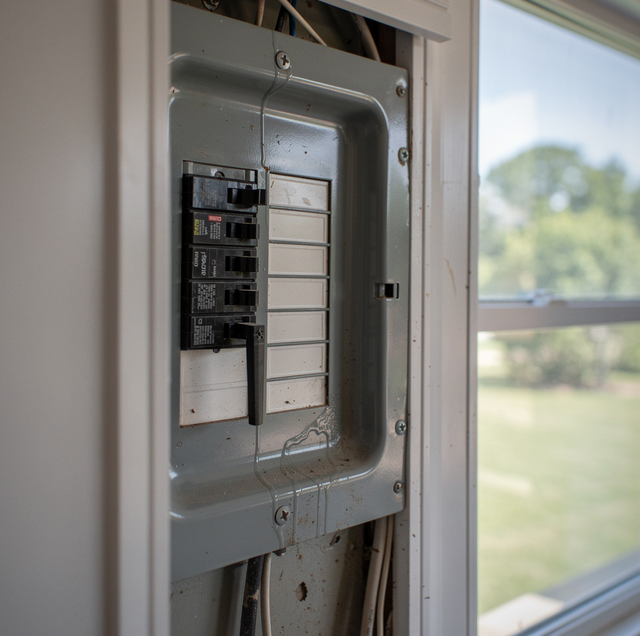
You flip the range hood switch and get nothing: no fan noise, no light, no click from the switch plate. That points to power, the switch itself, or the wiring feeding it, and the breaker is the first and only electrical step worth taking yourself. A different pattern changes the answer. If the light comes on but the fan stays silent, the fault narrows to the fan switch or the motor behind it, and grease buildup is the common thread that drags both toward failure over time.
The table below maps the pattern you're seeing to where the fault most likely sits.
| What's happening | Where the fault likely sits |
|---|---|
| Fan and light both dead | Power supply, main switch, or the wiring between them |
| Light works, fan stays off | Fan switch or the fan motor itself |
| Fan hums but the blade doesn't spin | Motor seized, a failed run capacitor, or the fan wheel bound by grease |
What a Completely Dead Range Hood Means
A hood with no response at all, neither fan nor light, is an electrical problem, not a mechanical one. The motor and the light bulb draw power from the same switch housing, so if nothing on the unit responds to any button or knob, the fault lies somewhere between the breaker panel and that housing. A loose wire nut, a corroded spade connector, or a switch that has failed internally can all produce the identical symptom: total silence. The breaker is the only one an owner checks; the rest are found with the hood cover off.
If the breaker won't reset, or trips again as soon as it is flipped back on, stop. That points to a short in the hood or the circuit feeding it, and tracing it is an electrician's job.
Checking the Breaker Before Anything Else
Find the breaker labeled for the kitchen circuit the hood sits on and confirm it hasn't tripped partway, which on many panels looks like it's still in the "on" position but sits slightly off-center from its neighbors. A lot of hoods share a circuit with something else in the kitchen, so the breaker that feeds the hood may carry the name of another appliance on its label. Switch it fully off, then back on. If the hood responds, it simply lost power due to a tripped breaker, and the next question is why it tripped. If it was already seated firmly in the on position and the hood is still dead, the breaker isn't the answer and the fault sits in the switch or the wiring run to it, which is diagnostic work rather than something to open up on your own.
When the Light Works but the Fan Doesn't
A working light with a dead fan rules out the breaker and the main power feed, since both components pull from the same supply. That narrows the fault to one of two places: the fan side of the switch, or the motor itself. Hood switch plates wire the light and the fan as separate circuits sharing one housing, which is exactly why one can fail while the other keeps working. A failed fan switch contact cuts power to the motor alone; a failed motor sits dead even with full power reaching it. Telling the two apart is what the next two checks are for.
Testing the Switch Before the Motor
A fan switch is the simpler part to test, and the one most hoods fail at first, so it gets ruled out before anything is said about the motor. It sits directly above the cooktop, so heat and grease work on it for years. The switch's internal contacts open and close every time the hood is used, and grease-laden air drawn across them over the years eventually coats the contact surfaces or corrodes the metal beneath, so the switch stops completing the circuit even though it still clicks normally. That failure mode looks identical to a dead motor from the outside: flip the switch, nothing happens. The distinction only shows up with the switch open and the contacts checked directly, which is why the switch and wiring are tested with the fan disconnected before a motor is ever quoted as the fix.
Washing the metal mesh grease filters about twice a year keeps grease out of the switch housing and the motor compartment both, cutting down on the two failures that start there.
Why Wiring Faults Hide Behind Grease
Wiring faults rarely announce themselves. A connector that has worked loose from years of cabinet-mounted vibration or heat cycling from the cooktop below looks no different from one that's seated properly, and it can still pass a visual check while failing to carry current. Grease plays a role here too: it collects on exposed terminals the same way it does on switch contacts, and over time it insulates a connection just enough to cut power intermittently before failing outright. A connection that's merely loose gets reseated rather than replaced, which is a meaningfully different repair from running new wire, and it's why wiring gets checked with the housing open rather than assumed from a dead switch reading alone. With the cover off, a hood has little to hide: the switch, the motor connector, and the wire nuts between them all sit within reach.
Signs the Fan Motor Itself Has Failed
A motor that's confirmed to have power reaching it, with the switch and wiring both testing good, has failed on its own terms. Two patterns show up. A silent motor with power confirmed at its connector can have a winding that has burned open, and that motor is replaced rather than repaired. A motor that hums without turning the fan blade is a different fault: current is reaching the windings and trying to spin the rotor, but something is stopping it, either a shaft or bearing gummed with hardened grease, or, on motors that use a run capacitor, a failed capacitor that leaves the rotor without its starting push. That second pattern is worth isolating carefully, because a stalled motor pulling full current without spinning can overheat and should not be left running while someone decides what to do about it. Noting which of the two a hood does, silence or a hum, before anyone opens it splits the diagnosis in half.
Keeping Grease From Causing It Again
Grease is the thread running through nearly every one of these faults: it coats switch contacts until they stop conducting, it insulates wiring connections until they drop out, and it migrates into a motor housing until the shaft binds. None of that happens in one cooking session. It builds over months of frying and searing, with the mesh filters left unwashed, and a hood that runs on a grease-soaked filter pulls that same grease-laden air straight past the switch and motor behind it. Cleaning the filters on a regular interval is the one maintenance step that reaches every one of those failure points at once.
A dead range hood rarely leaves three causes open at once. The symptom pattern, fan and light both out versus light-only, narrows it immediately, and the breaker, the switch, and the wiring get tested in that order before a motor is ever named as the problem.
Frequently Asked Questions
Many hood motors carry a thermal protector inside the windings that opens when the motor overheats and closes again once it cools. A fan that quits partway through cooking and comes back once it has cooled is the pattern of a motor running hot, often because a grease-loaded fan wheel is making it work too hard.
Not quite. On a touch-control hood, the buttons only signal a small control board, and relays on that board switch the fan and the light, so a dead panel can be the board or the ribbon cable to it. It is still tested power first, then the controls, then the motor.
Yes. A squirrel-cage fan wheel caked in old, hardened grease can bind tightly enough against the housing to stall a motor that turns freely once the wheel is removed and cleaned.
Yes. A bulb above the wattage marked on the socket overheats the socket, and the light switch contacts above a hot cooktop, and a scorched socket is a common reason a hood light quits. Use the wattage printed on the socket label or in the hood's manual.
No. A charcoal filter affects odor control in the recirculated air, not the start circuit, so a filter that's overdue for replacement cannot by itself keep a fan from turning on. A true no-start still points to power, the controls, the wiring, or the motor regardless of filter condition.
Some under-cabinet hoods plug into an outlet inside the cabinet above rather than being wired in. A plug that has worked partway out leaves the hood completely dead with the breaker on, so seeing that it is pushed fully home is the one check besides the breaker.
Schedule a range hood diagnosis — get the switch, wiring, and motor tested in order so the fan comes back safely, rather than guessing at a part. Tucker Appliance Repair serves Gardendale and Greater Birmingham. Call (205) 883-9703.