




Dryer Drum Won’t Turn, but the Motor Keeps Running: What’s Wrong
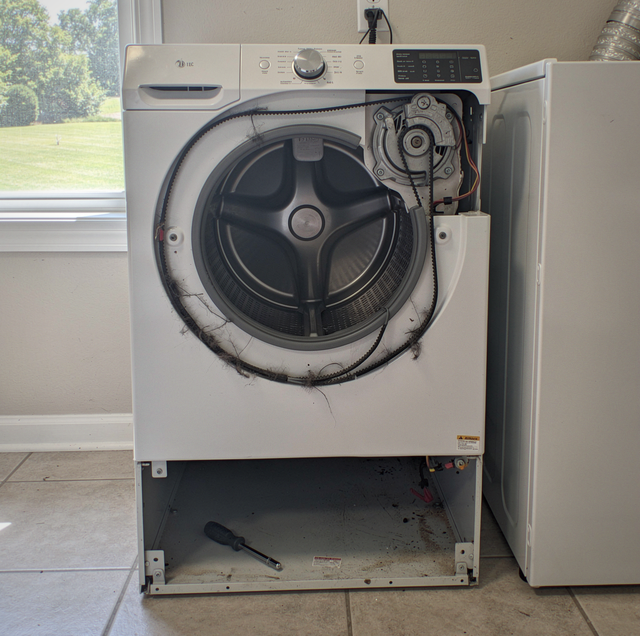
A clothes dryer's drum is not bolted to the motor shaft. The motor spins a small pulley, and a thin, flat belt loops fully around the outside of the drum, then routes under the motor pulley and around a spring-loaded idler pulley before its two ends meet. That belt is the only physical link turning the drum, so when it lets go, the motor has nothing left to pull against and keeps spinning on its own, which is the steady whir you hear with the drum sitting still.
The table below separates the sound and feel of the usual causes behind that pattern.
| What the motor does | What you can check by hand | Likely cause |
|---|---|---|
| Motor runs, drum turns freely when you spin it | A loose loop of rubber inside near the drum or motor | Broken or dislodged drive belt |
| Motor runs, belt intact but slack | Idler arm sits loose, or its spring has let go | Failed idler pulley |
| Motor runs, belt broken, drum hard to turn by hand | One spot drags or feels rough | Seized drum roller that wore the belt through |
| Motor hums but its pulley does not turn | Idler and rollers spin smoothly, belt is seated and taut | Motor's start switch or a winding, not the belt |
How the Belt and Idler Pulley Turn the Drum
The belt is tensioned, not bolted tight. A spring on the idler pulley arm pushes it against the belt partway around the loop, keeping just enough grip on the drum without binding the motor as it spins up. That spring tension is also what lets the belt flex around two pulleys and a drum rim without slipping under normal load. Fitting a new belt uses the same spring: pressing the idler arm toward the motor opens enough slack to slip the belt over the motor pulley, and releasing the arm lets the spring set the running tension on its own, with no separate adjustment.
The Thump or Snap That Marks a Broken Belt
A belt failing outright usually announces itself: a single thump or snap as it lets go, then quiet from the drum while the motor's whir often sounds lighter and a little faster, since it is no longer pulling against anything. Before that moment, a belt nearing the end of its life can squeal intermittently for days or weeks as it slips against the drum under load, particularly at the start of a cycle, when the load is wet and at its heaviest. A belt found off its pulleys, cracked across its ribs or glazed shiny on its face, has perished with age, and that alone explains the still drum. A belt does not always tear cleanly, either: on some dryers it walks off the pulley track instead, especially once the idler has drifted out of alignment, and in that case the belt stays in one piece but goes slack, so the motor keeps running smoothly rather than squealing first.
Why a Seized Idler Pulley Wears the Belt Down First
The idler pulley is designed to spin freely on its own small bearing, while the spring behind it maintains steady pressure on the belt. Once that bearing dries out or seizes, the idler stops rotating and instead drags against the moving belt, adding friction exactly where the belt is already under the most tension. That friction glazes and thins the belt over time, and a glazed belt is both weaker and more prone to slipping before it finally breaks. A seized idler is one of the two mechanical failures most directly tied to this symptom, the other being the drive belt itself failing from age.
When a Frozen Drum Roller Pulls the Belt Down With It
Drum rollers sit at the back of the drum, usually in pairs on a shared shaft, and carry the drum's weight so it can turn smoothly inside the cabinet. When one roller's bearing seizes, that section of the drum resists turning, and the belt has to work harder to drag it around each rotation. The added strain can stretch, glaze, or eventually snap the belt even though the belt itself was otherwise sound.
If the drum feels rough or catches when you spin it by hand, or you notice a hot rubber smell, unplug the dryer. Have a technician check the drum support and wiring before it runs another cycle.
Why the Motor Doesn't Shut Off When the Belt Breaks
On most dryers, the motor and the drum are not mechanically linked beyond the belt itself, so there is no reason for the motor to stop just because the drum has. It keeps spinning the same pulley it always did, now with no resistance from the belt. Some models work differently: a belt-tension switch rides against the belt, held closed by the belt's own tension, and when the belt goes slack, that switch opens and cuts power to the motor and the drum. On those dryers, a broken belt means everything goes quiet at once rather than leaving the motor running alone. A broken belt or a seized idler explains the drum-still-motor-running symptom on most dryers, but it is not the only wiring layout in use, so a sudden silence does not rule out the belt as the cause.
When the Belt and Pulleys Check Out but the Drum Still Won't Turn
If the belt is seated correctly and under tension, and the idler and both drum rollers spin freely by hand, the fault can sit inside the motor rather than in the drive train. A failed centrifugal start switch or an open start winding inside the motor can leave it humming under power without ever building up the speed to spin the pulley, and the motor's own overload protector then shuts it off after a short time. That is a different sound from a broken belt: a low hum with the motor pulley standing still, not a free-running whir, which is why checking the belt path by hand before assuming it needs a belt is worth the few minutes it takes.
Opening the Cabinet to Look at the Belt
With the dryer unplugged, most cabinets open from the front: removing the lower access panel or lifting the top exposes the belt loop around the drum. Spin the drum by hand. If it turns with little resistance and no belt is visible wrapped around it, the belt has broken or come off. If the drum turns stiffly, drags, or makes a grinding or scraping sound as it rotates, check the rollers and the idler pulley before assuming the belt is at fault, since replacing a belt without addressing a seized pulley or roller usually leads to a second failure soon after. Worn drum rollers found while the cabinet is open are best replaced during the same teardown rather than paying for a second one later.
A dryer whose motor runs while the drum stands still has power, which narrows the problem to the motor itself and whatever sits between it and the drum. Tracing that path by hand, before guessing at the first part that comes to mind, is what separates a quick fix from a repeat visit.
Frequently Asked Questions
On many dryers, the start button feeds the motor until a switch inside it closes at running speed and takes over. If the motor never reaches that speed, from a failed start switch or a drum that will not turn, the dryer stops the moment the button is released.
Most residential dryer belts are roughly a quarter-inch wide: long, flat belts with small ribs on their inner faces. The ribbed side faces the drum and the motor pulley, and the smooth side faces the idler wheel.
If its wheel wobbles on the axle or feels gritty when spun by hand, yes, since a rough idler glazes a new belt the same way it wore the old one. A smooth, quiet idler can stay.
It can. A soaked comforter or a drum packed tight asks the belt to lift more weight than it was sized for, and a worn belt slips or jumps the idler under that load. Large bedding dries best as a load of its own.
Belts for the common dryer platforms ride on the van, so a broken belt is normally finished on the first visit. An uncommon model can need its belt ordered, which is one reason the model number gets asked for on the phone.
No. On many electric dryers, the heater circuit runs through a switch on the motor, so the heat stays on whenever the motor spins; with the drum still, the same patch of fabric sits in the hot air stream and can scorch, and a loose belt can wrap the spinning motor pulley. Unplug it until the belt is replaced.
Have a technician trace the belt, idler, and rollers before anything gets replaced — the real fix depends on which one failed first. Tucker Appliance Repair serves Gardendale and Greater Birmingham. Call (205) 883-9703.