




New Dishwasher, Old Supply Line: What Carries Over
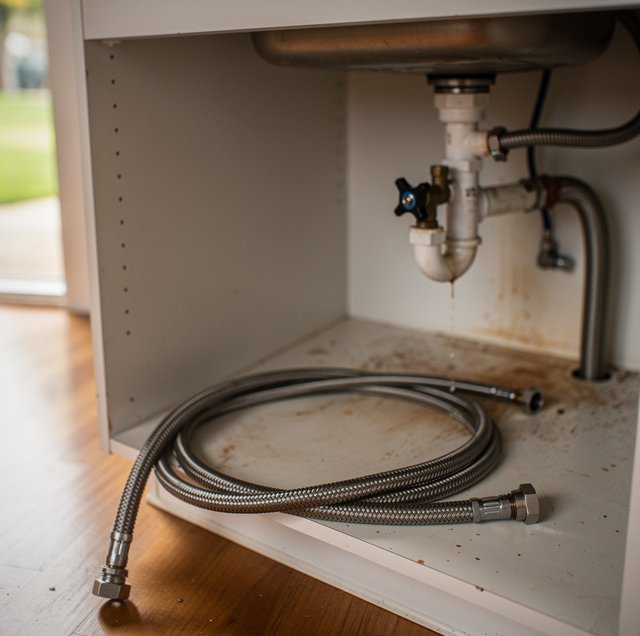
A like-for-like dishwasher swap does not automatically mean a new water line. Three things determine whether the existing line can stay in service: the condition of the line itself, whether its fitting matches the new machine's inlet valve, and whether the under-sink shut-off actually closes when you turn it. A fourth factor sits next to those three but is separate from the plumbing question entirely: whether the electrical connection the old dishwasher used is still adequate for the new one. Get those four right and a straight swap stays a single installation visit. Get one wrong and what looked like a simple appliance installation turns into a plumbing or electrical call first.
The Supply Line Itself: Material, Age and Condition
A braided stainless steel supply line is the standard connection on dishwashers installed in the last couple of decades: a flexible hose with a mesh stainless jacket over an inner rubber or polymer core, connecting the shut-off valve to the dishwasher's water inlet valve. Older installs sometimes still use a short run of rigid copper tubing bent to shape, and a smaller number use plain reinforced plastic tubing, which tends to show its age faster than either of the other two. Plastic tubing is not recommended for dishwasher supply lines, so now is the moment to swap it for braided hose or copper.
A braided line that still looks clean on the outside is not automatically fine on the inside. The braiding can mask corrosion in the inner core, and a line that has sat behind a dishwasher for close to a decade is a candidate for replacement on age alone, regardless of anything visible. Check the full length for kinks, flattened spots where the dishwasher's cabinet pinched it during the last install, and any crusty white or greenish buildup around either end, since that buildup marks a joint that has been weeping slowly rather than leaking outright. Joints like that turn up often on an old install: a fitting that has wept gently since the day it was made, never quite loose enough to drip.
A rigid copper line that has never been disturbed generally holds up fine, but once you unscrew the nut at either end to swap appliances, you are relying on that fitting to reseal cleanly a second time, which is not guaranteed on every type of connection.
Before deciding to reuse the line, flex it gently along its full length. A braided line that crackles or feels stiff in spots rather than uniformly flexible has internal damage worth replacing before it fails behind a running dishwasher.
Fitting Compatibility at the Valve
The line's other end meets the dishwasher at its inlet valve, on most machines via a brass 90-degree elbow with a 3/8-inch compression outlet; some newer models use a 3/4-inch hose-thread connection and require a line with that end instead. The new machine's installation sheet shows which, and it is worth reading before the old unit comes out. The line's own ends come in two kinds, and they behave differently once disconnected.
A braided line's nuts have built-in seals and reconnect the same way they came off. Rigid copper is different: its compression nut squeezes a brass ring, called a ferrule, onto the tubing, and that ring stays crimped to the tube once tightened.
The table below compares how each behaves on a repeat connection.
| Connection | What makes the seal | On a repeat connection |
|---|---|---|
| Braided connector nut | A seal built into the nut | Reconnects cleanly if the threads and seal are undamaged |
| Copper compression | A ferrule crimped onto the tubing | Can reseal into the same fitting; a weep on retightening means a new ferrule or a new line |
The wall end of the line rarely changes between an old dishwasher and a new one, so whatever is already there is what you are working with.
The Under-Sink Shut-Off: The Real Gatekeeper
The valve that controls how the rest of the job goes is not at the dishwasher at all. It is the shut-off under the sink, and its condition decides whether the swap proceeds smoothly or stalls before it starts.
Two valve types show up under kitchen sinks. A quarter-turn ball valve has a lever handle that moves 90 degrees from open to closed, and its internal ball either seals fully or it does not; there is little middle ground, and it is far less prone to seizing than older multi-turn stops. A multi-turn gate or compression-style stop valve, more common in older houses, closes by threading a stem down over several full turns, and that stem can seize in place from mineral buildup or corrosion if the valve has not been operated in years. A stop left untouched for that long is the most common holdup in a dishwasher swap: it either will not close or will not seal once it has closed.
Before anything else gets disconnected, that valve has to hold. A valve that will not fully close, or that keeps weeping past the closed position, requires a separate plumbing repair before the swap can proceed.
The Electrical Connection
A dishwasher connects one of two ways: hard-wired, with the house cable running into the machine's own junction box behind the lower kick panel, or plug-in, with a power cord kit running to an outlet under the sink. On several new dishwashers, that power cord kit is sold as an accessory, not included in the box, so it needs to be on hand before the old unit comes out.
The circuit itself is worth a separate check from the outlet or junction box hardware. The circuit the new machine calls for is printed on its installation sheet. An older house where a dishwasher was added after the fact sometimes has it tied into a circuit shared with other kitchen loads, and a swap does not change that; an electrician does.
If the junction box shows scorched insulation, a loose wire nut, or the breaker trips repeatedly once the new unit is connected, stop and have an electrician check the circuit before the dishwasher runs again.
What a Like-for-Like Swap Involves
With the supply line, fitting and shut-off checked, the swap itself follows a fairly consistent sequence: shut off the water and power, disconnect the old unit's water line, drain line and electrical connection, slide the old machine out, and set the new one in place. The drain hose comes attached to the new machine, so that connection is a matter of routing and clamping it, not sourcing a part.
Once the new machine is positioned, the existing supply line (or its replacement, if the line was swapped) connects to the new inlet valve, the power connection is made at the machine's junction box, and the unit gets run through a cycle with the cabinet open. Hence, any leak at the fittings shows up immediately rather than after everything is closed back up. A dry fitting that weeps once water pressure comes back on is far easier to catch and retighten in those first few minutes than to discover later from water damage under the cabinet.
Where Appliance Work Stops and Plumbing or Electrical Work Begins
A plain like-for-like swap stays appliance work as long as the existing line, fitting, and shut-off are sound and the existing circuit is adequate. The moment any of those is not true, the job changes category. Running a new supply line through a cabinet or wall, replacing a shut-off valve, or adding or rerouting a dedicated circuit are plumbing and electrical jobs, respectively, not appliance installation, and they call for a plumber or an electrician rather than being folded into the appliance swap.
That line matters because it is easy to assume a dishwasher installer handles anything under the sink. The reasonable expectation for an appliance swap is to connect to what is already there and functional, not to build new infrastructure to support it.
Signs the Line Should Be Replaced Anyway
Even when a line still works, replacing it during the swap makes sense for a line near a decade of service, one with mineral crust at either fitting, or one with a kink or flattened section. None of those failures announces itself before it happens; a supply line keeps working right up until the fitting lets go.
Treat the decision the way you would treat any small part that is simple to replace and inconvenient to have fail: swapping the line while the cabinet is already open takes a few extra minutes, and skipping that step is a trade that rarely pays off.
Whatever the line, fitting and shut-off turn out to be, the decision is seldom about whether a new dishwasher can connect to an old line; with the right end on the line, nearly all of them can. The decision is about whether what is already there is still doing its job.
Frequently Asked Questions
It can, if its threads are clean and undamaged and it matches the new valve. Read the new machine's installation sheet before reaching for tape: some call for no tape or thread sealer on the valve threads at all, and a hose-thread connection seals on a rubber washer that has to be seated inside the fitting before the nut goes on.
Inlet valves sit at the front behind the kick panel, on the left on some models and the right on others. A line that just reached the old valve can come up short, or end up crossing under the tub against the drain hose; a longer line, run clear of the frame, is the fix.
The hot supply on a standard install, often through a dual-outlet stop under the sink that also feeds the faucet's hot line. Closing that one valve cuts hot water at the faucet too, which is normal during the swap.
Yes. With the line's free end in a bucket, opening the stop for a few seconds flushes out scale that broke loose when the valve was turned. Left in the line, that grit lodges in the new inlet valve's screen on the first fill.
Hand-tight, then a quarter to a half turn with a wrench. Overtightening can crack the seal inside a braided line's nut or split the brass elbow, which leaks worse than a nut that one more small turn would have stopped.
Sometimes, if its gauge and plug match what the new machine's installation sheet calls for. The strain-relief bushing where the cord enters the junction box is often machine-specific, though, so a cord kit made for the new model is the cleaner route.
Schedule your dishwasher swap — have the existing line, fitting, and circuit checked before the new unit goes in, so a mismatch gets caught before it becomes a return trip. Tucker Appliance Repair serves Gardendale and the Greater Birmingham area. Call (205) 883-9703.
