




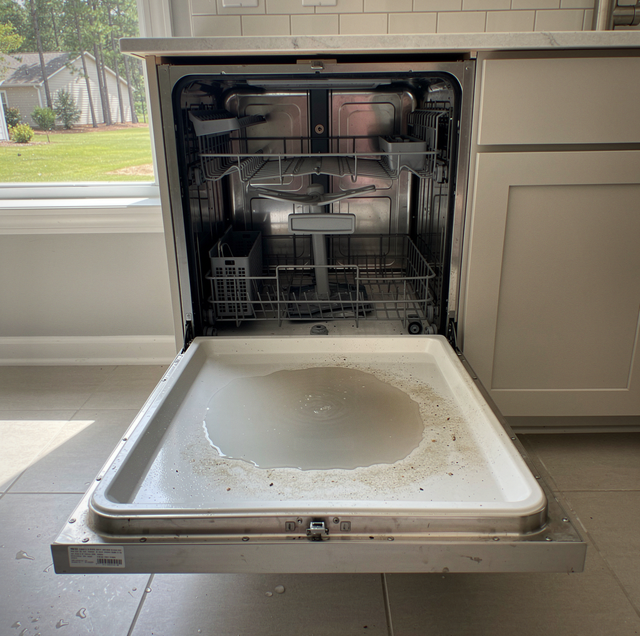
A modern dishwasher runs two separate pumps to perform two distinct jobs, and the symptom you are looking at indicates which one is involved. One pump circulates water up through the spray arms during the wash and rinse portions of the cycle. A second, smaller pump switches on only at the end, to push the used water out of the tub and down the drain hose. When a cycle finishes, and you open the door to a puddle at the bottom of the tub, the wash pump has already done its job hours before you noticed anything wrong. The part that failed, or the blockage that is sitting somewhere in its path, belongs to the drain side.
The table below distinguishes between the two failure patterns, since mixing them up can send an owner chasing the wrong part.
| Symptom | Points to |
|---|---|
| Water left in the tub at the end of a finished cycle | Drain pump, its impeller, or the path water takes out of the machine |
| Dishes still dirty or gritty, tub drains fine | Wash pump, spray arms, or the filter screen below them |
| Water drains, but slowly, over several minutes | A partial blockage rather than a dead pump |
| Dishwasher and kitchen sink both hold water at once | A fault downstream of the dishwasher, in the house drain line |
How the Drain Pump Differs From the Wash Pump
The wash pump sits at the bottom of the tub and draws water through a coarse filter before sending it back up to the spray arms, over and over, for most of the cycle. The drain pump is a separate motor and impeller, mounted beside or beneath the wash pump assembly, and it only spins during the short drain phase that follows a wash or rinse. Because the two motors perform opposite functions on opposite schedules, a machine can wash and rinse normally and still leave standing water, which is exactly what happens when the fault occurs only on the drain side.
Lift out the removable screen at the bottom of the tub and rinse it under the tap before assuming the pump has failed. A packed screen can slow drainage enough to look like a dead pump.
What Blocks the Drain Pump's Impeller
The drain pump's impeller spins inside a small chamber at the bottom of the sump, and anything small enough to slip past the coarse filter above it can lodge against the blades: a piece of broken glass, a fruit pit, a bottle cap, a chip of bone, or a label that peeled off a jar. A jam can leave the motor running, so a soft hum or buzz from under the tub during the drain phase, with no water leaving, is a different problem from a motor that goes completely silent. The hum indicates an impeller that cannot turn, due to an obstruction or a seized pump bearing. Silence points to a motor that has failed outright, a lost electrical connection, or a control that never called for the drain.
Hard water is rarely the reason a dishwasher holds water, on a hard supply or a soft one. Scale builds first where fresh water enters under pressure, at the inlet valve screen, while the drain pump moves warm, detergent-laden waste water out, so a puddle in the tub sends the search to the filter and the impeller before anyone tests the water.
The Garbage Disposal Knockout Plug Owners Can Check
On a dishwasher connected to a garbage disposal, the disposal has a dedicated inlet port for the dishwasher's drain hose, sealed at the factory by a knockout plug. That plug has to be punched out from inside the disposal before the connection is made. On a newly installed dishwasher, or one installed alongside a new disposal, standing water with no other symptoms can be traced back to a plug that nobody removed, which blocks the path completely rather than partially. This is one of the few checks an owner can make without opening the dishwasher itself: look at the hose connection on the disposal side and confirm the port is open.
Where a Kinked Hose or Clogged Air Gap Slows the Flow
The flexible drain hose runs from the dishwasher, up and over to clear the sink's drain level, then down into the disposal or drain line. That high point in the hose is deliberate: it prevents wastewater from the sink drain from flowing back into the dishwasher tub between cycles. A hose pinched behind the cabinet, coiled too tightly, or sagging below that high point can restrict flow enough to leave a shallow puddle without stopping drainage altogether, and a hose that has slumped down over time is easy to miss since nothing about it looks obviously broken. Some kitchens also have a small cylindrical air gap fitting mounted on the sink deck near the faucet, whose job is to let air break any siphon between the sink drain and the dishwasher. Debris can pack into that fitting over time, and a clogged air gap shows up as the same slow, incomplete drain as a kinked hose, so both are worth a visual check before assuming the pump itself is bad.
A Shared House Drain That Backs Up
A dishwasher's drain pump pushes water into a shared line that also carries the kitchen sink's drain, and, where one is fitted, the garbage disposal's own discharge. If that shared line is blocked further downstream, the pump can run perfectly and still have nowhere to send the water it is pushing.
If the kitchen sink backs up along with the dishwasher tub, the blockage sits in the shared drain line. Call a plumber instead of running the cycle again; another cycle only adds water to a line that cannot carry it away.
A clear way to tell the two apart: run the dishwasher by itself, with the sink and disposal otherwise idle, and watch whether water backs up into the sink basin while the dishwasher drains. If it does, the appliance is not the problem.
Signs the Drain Pump Itself Has Failed
Once a blockage, a kinked hose, and a shared-line backup are ruled out, what is left is the pump itself: a worn-out motor, a cracked impeller, or a connector that has corroded enough to break the circuit. A pump that hummed on earlier attempts and now makes no sound at all during the drain phase has gone from obstructed to failed. Removing the pump cover exposes the impeller and allows a jam to be cleared from a motor that needs replacing. An impeller with a cracked or missing blade can also spin freely without moving much water, which, from the outside, looks like a jam even though nothing is blocking it. So, a visible crack in the plastic is worth checking before writing the whole pump off as obstructed.
Standing water left in a dishwasher for more than a day or two is more than an inconvenience: food residue sitting in warm water starts to smell within a cycle or two, and that smell can linger even after the machine drains again. Working through the filter, the disposal connection, the hose, and the pump in that order finds the cause before it reaches that point.
Frequently Asked Questions
Some do. A model that times its drain can flash a drain fault light or code when the water level does not drop in the time the control allows, which sends the search to the drain side from the start. Other models give no warning at all, and the puddle is the first sign.
Running the disposal briefly before a load clears any food sitting in its chamber, on a hookup that routes the dishwasher's drain hose straight into the disposal's own inlet port. An already-full disposal chamber gives the dishwasher's pump less room to push water into.
A thin film or a few scattered drops around the edge of the tub is residue that air-drying leaves behind. Water sitting deep enough to cover the bottom of the tub, or pooling around the filter, is beyond normal residue and indicates a drain fault.
Not always. A dishwasher that drains completely and still smells between loads can have a greasy film coating the inside of its drain hose, a separate problem from a pump that is not clearing water and one that a hot cycle with the filter cleaned does not reach.
No. A backup that only occurs when another fixture on the same branch line is in use points to a restriction downstream in the house drain, since the dishwasher's own pump has no way to push water past a blockage beyond the appliance.
Yes, when the object comes free and the impeller blades are whole. With the power off at the breaker, a technician opens the pump cover, which on some models sits under the filter inside the tub, and lifts the object out with pliers, since the jam can be a shard of glass. A motor that has burned out or seized is a different repair: the pump is replaced.
Text a photo of the model plate and say whether the pump hums or stays silent — that detail narrows it to the drain pump, a blockage, or the house drain before a visit is booked. Tucker Appliance Repair serves Gardendale and the Greater Birmingham area. Call (205) 883-9703.